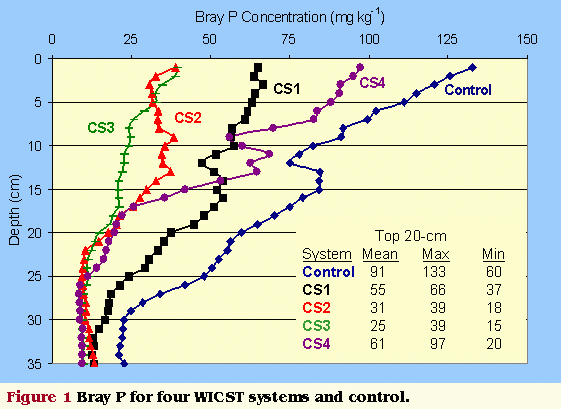
Best management practices, including reduced and no-tillage management,
for different cropping systems on the same soil has led to continued vertical
stratification of Bray P (Figure 1). The control reflects a pre-1989 history of
heavy manuring and minimal tillage. Cropping systems 1 and 2 receive starter
fertilizer, while system 4 receives manure applications and system 3 receives
absolutely no fertilizer input. Comparison of systems 1, 3, and 4 shows the
effect of intentional P drawdown, as well as vertical stratification persisting
despite repeated chisel plowing. However, cropping system 2 shows no
stratification in the top 20-cm, probably due to conventional tillage between
1989-94. Where vertical stratification has occurred, the range of measured P
values is so large that the meaningfulness of a mean is uncertain.
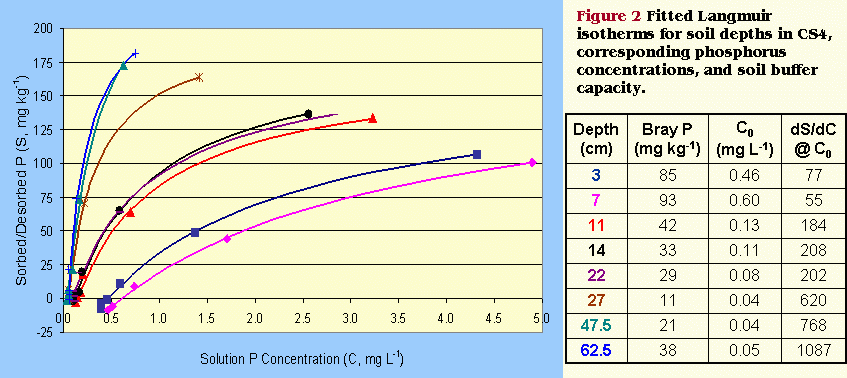
Langmuir sorption isotherms differ systematically with soil depth, including within the plow layer, and reveal the soil solution P concentration as well as the soil capacity to sorb additional phosphorus (Figure 2). Soil profiles may become oversaturated with respect to P and, depending on location and mobility, the phosphorus may be more susceptible to overland runoff or leaching below the root zone.
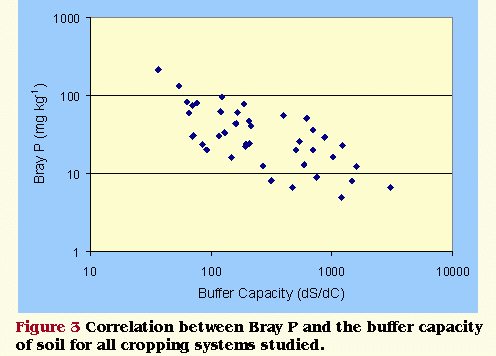
Bray P is inversely correlated to soil buffer capacity (Figure 3). As
Bray P increases in a soil profile, the ability of the soil to sorb additional
phosphorus is reduced. Additional data, not reported here, shows a positive
correlation between Bray P and soil solution P concentrations, indicating a
change of P mobility within a profile.
Soil solution P concentrations (C0) from sorption measurements are strongly correlated with phosphorus concentrations in soil solution collected at natural soil:water ratios by heavy liquid, immiscible displacement (results not shown). Use of microplate methodology (Avila-Segura et al., 2004) quickly and efficiently determines phosphorus sorption parameters which can be fit to Langmuir equations for C0 determination.
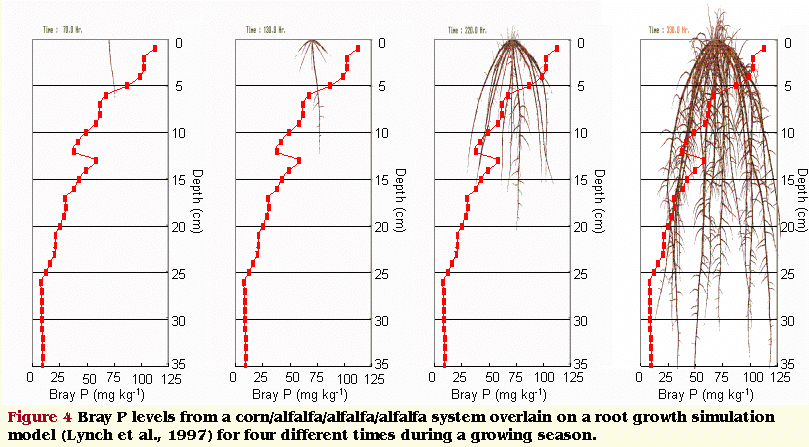
As root growth transects the soil profile, individual roots encounter different nutrient levels and P buffer capacities, none of which are identical to the “average” for the bulk sample. When roots reach a depth of 20-cm, they are no longer in contact with adequate phosphorus levels (Figure 4).