Carbonates, Evaporites, and Accessory Minerals
Readings
Doner, H.E., and W.C. Lynn. 1989. Carbonate, Halide, Sulfate,
and Sulfide Minerals. Ch. 6, p. 331-378. In: J.B. Dixon and S.B. Weed
(ed.), Minerals in Soil Environments, 2nd Edition.
Carbonates
Carbonate minerals come in a variety of forms with a variety
of cations. The two most common polymorphs of calcium carbonate,
CaCO3 give their names to two different isotypes, the calcite
isotype and the aragonite isotype, which differ in their crystal structure. The
calcite isotype is trigonal of space group R-3c, with a rhombohedral unit cell,
while the aragonite isotype is orthorhombic of space group Pmcn. The difference
in "packing" of Ca and CO3 into the two polymorphs creates a slight
but significant difference in density, expressable as molar volume. Cations
smaller than Ca2+ can fit into the calcite structure in which 6
oxygens encompass the central metal cation but cations larger than
Ca2+ fit into the denser aragonite structure that surround each
metal cation with 9 oxygens. (Shades of Pauling's Ratio Rule!!)

Oddly, yet a third, relatively rare calcium carbonate
polymorph is known--vaterite. It too is orthorhombic, with space group Pnma,
and packs 8 oxygens around each Ca2+. In recent years, a fascinating
method of producing vaterite crystals has been reported. A thin layer of
stearic acid is placed over a supersaturated solution of calcium bicarbonate
and compressed to form a highly structured monomolecular layer, oriented with
the ionized carboxylate groups of the stearate forming a negatively charged
layer in the solution. The spacing of the cations in vaterite does not coincide
with the spacing between the charged groups in the stearate layer so it is
presumed that the stearate does not serve as a template as much as simply
"condensing" Ca concentration in the vicinity of the layer to make formation of
vaterite favorable.
In addition to the single metal species of the calcite isotype,
i.e., Co (sphaerocobaltite), Mg (magnesite), Ni (gaspeite), Zn (smithsonite),
Fe (siderite), Mn (rhodocrosite), Cd (otavite), and Ca (calcite), regular
interlayering of Ca and Mg produce both dolomite,
CaMg(CO3)2, and huntite,
CaMg3(CO3)4.
Isomorphous Substitutions among Carbonates
With so many different metal carbonates that can be formed all
within the same space group, it is not surprising that many "impurities" are
found. For example, calcite will often contain as much as 5 or 10% Mg
substitution, sometimes even more if the calcite is of biogenic origin, and is
known as magnesian or magnesium calcite. Changes in the specific x-ray spacings
of calcite have been used to quantify the degree of Mg substitution in
calcites. Magnesite (MgCO3) has a solid solution series to siderite
FeCO3which has a solid solution series to rhodocrosite
(MnCO3). Interestingly, dolomite (CaMg(CO3)2)
has relatively little deviation from an ideal 1:1 Ca:Mg ratio, except when the
Mg is substituted by Mn, leaving the Ca layer intact.

Carbonate Occurrence
The table below provides compositions and occurrences of a
variety of common carbonates:
| Mineral |
Composition |
Occurrence |
| Calcite |
CaCO3 |
soil, limestone, igneous |
| Aragonite |
CaCO3 |
biological (shells, molluscs) |
| Siderite |
FeCO3 |
sediments |
| Nesquehonite |
MgCO3 · 3H2O |
evaporite |
| Magnesite |
MgCO3 |
evaporite |
| Dolomite |
CaMg(CO3)2 |
dolostone |
| Soda |
Na2CO3 |
evaporite |
The most common carbonate mineral in soils is calcite, present
in ~30% or more of the world's soils. Calcite is sparingly soluble in soil
solution, with higher solubilities at lower pH values. Free calcium carbonates
typically do not persist in soils with pH values below 7.0, except as
unweathered fragments, and pH values of 7.5 to 8.2 are not at all uncommon for
calcareous soils. In calcareous soils, calcite is often found in the silt and
the clay (<2 µm) size fractions, often as a result of secondary
precipitation, if the method of sample preparation has not removed carbonates
before analysis. Sorption of phosphate on calcite is well-known. Calcite may
occur in soils from a variety of sources: as rock or sand-sized grains
inherited from parent rock; as diffuse secondary carbonates of pedogenic
origin; as threadlike or soft masses of secondary carbonates; as casts around
roots; or as moderately to highly cemented petrocalcic horizons. Aeolian
origins are also common in semi-arid to arid environments.
Of the two other polymorphs of calcium carbonate, aragonite is
occasionally present in soils, usually inherited from parent material or fresh
shells. Vaterite has not been found in soils.
 |
 |
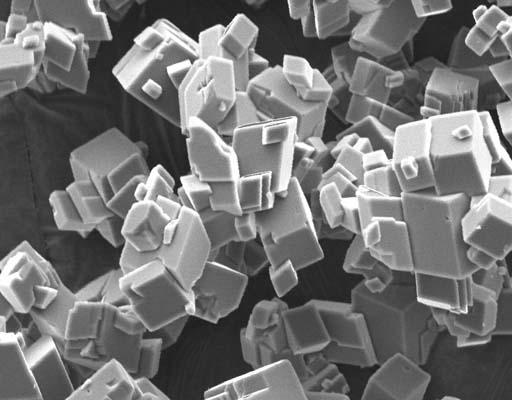
| Precipitated calcite crystals, scanning electron
microscope x1250. Nater, Sherman, and Barak, 1996. |
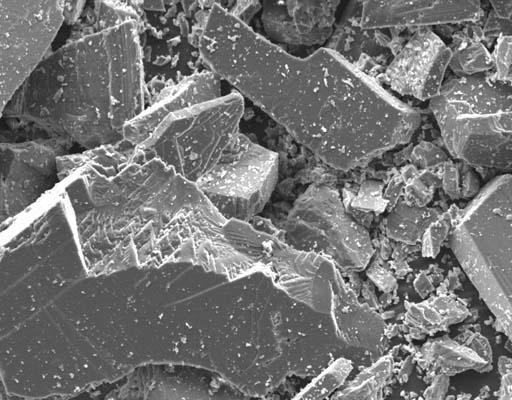
Ground dolomite crystals, scanning electron
microscope x1250. Nater, Sherman, and Barak, 1996. |
Other soil carbonates occur either from the parent material
(such as dolomite), in sediments (siderite), or as evaporites (magnesite,
nesquehonite, and soda). There are scattered reports of pedogenic dolomite in
the literature but are often discounted a priori because of the absolute
failure of all attempts to form dolomite under laboratory conditions at earth
surface temperatures, i.e., without significant heat and pressure. In fact,
little evidence exists of the contemporary formation of dolomite under any
natural circumstances, which leads to "The Dolomite Question", where did all
the tens and hundreds of meters of solid dolostone come from? Considering the
possibility of dolomitization of calcite as an explanation, it has been
calculated that the amount of time required for solid diffusion of
Mg2+ from seawater into limestone deposits to convert calcite to
dolomite exceeds the life-span of the earth! Also, difficult to imagine how the
miscibility gap between magnesian calcites and dolomite is bridged. Magnesite
is similarly difficult to impossible to form in the laboratory under earth
surface conditions. Large amounts of dolostone (="dolomitic limestone") are
used as agricultural limestone in acid soils.
Siderite
(FeCO3) is reported to be formed in significant amounts in brackish
and freshwater swamp sediments but is chemically unstable if the sediments are
drained and therefore oxidized. Although it is held by Donner and Lynn (1989)
that siderite does not form as a secondary mineral in soils, explanations of
the chemistry of paddy soils--a seasonally reducing environment in which
decomposing organic matter produces significant concentrations of dissolved
CO2/bicarbonate and Fe2+--usually invokes the formation
and dissolution of siderite as a factor.
The carbonate contents of soils are typically measured by
measuring CO2 evolved either upon addition of acid or heat
(>900°C). Distinction between dolomite and calcite has been made by
differences in rate of acid dissolution. Staining techniques have long been
used to identify calcite, aragonite, dolomite, and magnesian calcite. The
presence of calcium carbonates is well-known to interfere with standard methods
of determining exchangeable Ca2+ by displacement with buffered salt
solutions, e.g., 1 M NH4OAc at pH 7, and determinations of
cation exchange capacity or "effective" cation exchange capacity by such
techniques are inherently flawed when applied to calcareous soils.
All carbonates weather fairly readily; the evaporites are
readily soluble in water, but the calcium carbonates and dolomite have
relatively low solubilities in circumneutral soils and can persist or even form
in soils in semi-arid to arid environments. Secondary calcium carbonates or
gypsum are one of the most common indicators of soil development in semi-arid
and arid environments.
Evaporites
Evaporites are minerals that form readily by precipitation
during the evaporation or desiccation of a solution and that have solubilities
equal to or higher than that of gypsum. The term does not describe a specific
group of minerals based on composition or structure, but rather on their
behavior in soils and sediments.
The most commonly occurring evaporites in soils are members of
one of the three groups given below. The following is only a partial list of
the many species that can be found in soils, near seeps, or in evaporite
basins.
Sulfate Minerals
| Sulfate Species |
Composition |
Occurrence |
| Gypsum |
CaSO4 ·2H2O |
soils, gypsiferous rock |
| Anhydrite |
CaSO4 |
evaporite |
| Mirabilite |
Na2SO4·10H2O |
evaporite |
| Thenardite |
Na2SO4 |
evaporite |
| Epsomite |
MgSO4 · 7H2O |
evaporite |
| Bloedite |
Na2Mg(SO4)2 ·
4H2O |
evaporite |
| Barite |
BaSO4 |
evaporite |
| Jarosite |
KFe3(OH)6(SO4)2 |
acid sulfate soils and mine drainage waters |
Gypsum is the most common evaporite mineral occurring in
soils. A saturated solution of gypsum is 15 mM CaSO4; hence,
it is generally found in environments more arid than those required by
considerations of calcite persistence, and is often associated with soils with
a high soluble salt content as well. It can be inherited from gypsiferous
parent materials or formed as a secondary mineral. It can occur as fibrous
masses, small dispersed crystals, concretions, or in petrogypsic horizons where
it cements soil materials together. It is moderately soluble in water and can
be easily leached from soils. Parent materials high in gypsum can form
pseudo-karst landscapes where the gypsum has been leached, producing caves and
subsurface porous features. Even simple irrigation of highly gypsiferous soils
can produce significant pseudo-karst features, including sinkholes.
Gypsum--either from geological deposits or industrial by-products--is
occasionally used to ameliorate sodic soils; dissolving gypsum supplies not
only Ca2+ to replace exchangeable Na+ but also increases
the total electrolyte concentration to prevent dispersion of clays.
Other sulfate minerals are of more restricted occurrence. For
example, mirabilite and thenardite have been found in evaporation ponds
receiving drainage waters from soils of the Kesterton Reservoir project in the
San Joachin Valley of southern California. Jarosite is an oxidation product of
iron sulfides in acid sulfate soils and in acid mine drainage water.
Measurement of the gypsum content of soil usually involves
adding sufficient water to a sample to dissolve the gypsum entirely and then
determining the amount of calcium sulfate or additional salt in that water
extract. Standard methods for determination of exchangeable Ca2+,
cation exchange capacity, and soluble salts in soil solution are of dubious
value for gypsum-containing soils and special modifications are required to
compensate for the tendency of gypsum to dissolve into the extracting solutions
until exhausted.
Chloride Minerals
| Chloride Mineral Species |
Composition |
Occurrence |
| Halite |
NaCl |
evaporite |
| Sylvite |
KCl |
evaporite |
Chloride minerals are highly soluble in water and can be
readily leached from soils. They typically occur only in areas, such as playas,
seeps, or discharge areas, that collect subsurface flow.
Among the evaporites are to be found potassium ores, extensively
mined primarily for fertilizers. Among them, sylvite (KCl) above, but also
"double salts" with magnesium, such as carnallite
(KCl·MgCl2·6H2O), kainite
(KCl·MgSO4·2¾H2O), and langbeinite
(K2SO4·Mg2(SO4)2).
Nitrate Minerals
Nitrate minerals are relatively uncommon except in very arid
areas and occasionally in seeps and dry caves. They are all highly soluble.
| Nitrate Mineral Species |
Composition |
Occurrence |
| Niter |
KNO3 |
evaporite |
| Nitratine |
NaNO3 |
evaporite |
| Nitrocalcite |
Ca(NO3)2 · 4H2O
|
evaporite |
| Nitromagnesite |
Mg(NO3)2 · 6H2O
|
evaporite |
General Characteristics
Because evaporite minerals are all soluble in water to some
degree, they only occur in relatively arid sites or locations in the soil where
desiccation occurs. They are generally associated with areas where
evapotranspiration (ET) is much greater than precipitation, and leaching does
not occur to great depths. They may also occur in seeps where water reaches the
surface from subsurface flow. Consequently, evaporite minerals are seldom
observed in soils that are not in ustic, aridic, or xeric moisture regimes.
Deposits of nitratine, mined as caliche in Chile, was marketed for many years
as "Chilean saltpeter" was an important nitrogen fertilizer source before the
industrial fixation of N2 by the Haber-Bosch process.
When present, evaporite minerals have a major influence on the
behavior of the soil. They greatly affect physical and chemical properties such
as swelling behavior, pH, and soil aggregate stability. Their greatest effect,
however, is on the biological processes occurring in soils, as the presence of
quantities of evaporite minerals more soluble than gypsum can cause significant
osmotic potentials in the soil that are detrimental to plant growth.
Methods used to study evaporite minerals
Because evaporites are very soluble, they will dissolve if
samples are exposed to the normal pretreatments used prior to XRD analyses.
Consequently, other techniques must be used. The most obvious technique is to
use random powder XRD on dry, ground samples of whole soil. This method is good
if the evaporite mineral constitutes more than about 5 % of the total mass of
the sample; otherwise the peaks associated with the evaporite minerals may be
lost in the background noise. If the evaporite constitutes a smaller fraction,
it can sometimes be removed from the soil by hand picking of macroscopic
crystals, which is often the case. However, this doesn't work for fine-grained
crystals, and other methods must be employed.
For minerals for which these techniques will not work, it is
sometimes considered acceptable procedure to dissolve the evaporites by placing
the sample in an excess of water, and then reform them by allowing the extract
to desiccate. This method may produce artifacts, especially when dealing with
minerals that form several hydrated polymorphs. Selective dissolution
treatments (or even water) can be used in conjunction with chemical methods.
One can also dissolve all but one kind of mineral if one uses solutions that
are saturated with respect to the mineral of concern.
Likewise, excessive sample drying (especially at elevated
temperatures) can cause the transformation of some hydrated minerals into less
hydrated forms, thus changing the mineral structure and providing false
information.
It turns out that one of the easiest ways to identify many of
the evaporite minerals is by SEM morphology in conjunction with energy
dispersive x-ray (EDX) analysis. The combination of compositional analysis and
morphology are often conclusive, although there is some problem with the
carbonate minerals, as C and O are not detectable by most EDX analyzers. In
modern instruments one can also determine structural parameters by rocking beam
techniques and the patterns thus produced.
Sulfides and Sulfide Oxidation Products
Sulfides form under strong reducing conditions in the presence
of sulfates. Sulfate is reduced to sulfide (S2-) ion and complexes
with reduced metal ions, particularly Fe2+. Many other metals can
form sulfides; Fe is just more common than most of them. Most sulfides are
relatively impure, scavenging available metals from solution. Additionally,
sulfides often form so rapidly that the minerals produced are poorly
crystalline, making identification difficult if not impossible.
Numerous types of sulfides can be present as inclusions in
primary minerals or igneous or sedimentary rocks, but they oxidize rapidly once
exposed to aerobic soil environments. The oxidation process is typically driven
by sulfide oxidizing bacteria. Oxidation of sulfide releases huge quantities of
hydronium ions, driving the pH very low. Acid mine drainage, caused by
oxidation of high sulfide coal wastes, can have pH values significantly lower
than pH 1.0.
Sulfide oxidation products are minerals formed during the
rapid oxidation of sulfides, typically by sulfur oxidizing bacteria. The two
most common minerals are jarosite and natrojarosite. Both have yellow crystal
form and typically have a strong sulfurous smell.
Compositional and occurrence data are given below.
| Sulfide Mineral Species |
Composition |
Occurrence |
| Pyrite |
FeS2 |
reduction product |
| Marcasite |
FeS2 |
reduction product |
| Mackinawite |
FeS |
reduction product |
| Greigite |
Fe3S4 |
reduction product |
| Jarosite |
KFe3(OH)6(SO4)2
|
oxidation product |
| Natrojarosite |
NaFe3(OH)6(SO4)2
|
oxidation product |
Accessory Minerals
Accessory minerals are those minerals that occur in small
quantities in soils. They are generally inherited from the parent materials,
and many of them are very resistant to weathering (i.e., they are relatively
inert from a chemical perspective).
Igneous rocks are commonly dominated by a few to several
minerals from one or more of the silicate classes. Quartz and feldspars
dominate most mineral assemblages, but some more basic rocks may be dominated
by feldspars, pyroxenes, olivines, and even chlorites. However, many other
minerals are usually present, occurring in such small quantities and/or small
crystal sizes that they are easily overlooked. These minerals commonly occur as
very small crystals, usually of silt size, and are often present as inclusions
in other, larger crystals.
| Accessory Mineral Species |
Composition |
Occurrence |
| Rutile |
TiO2 |
primary |
| Anatase |
TiO2 |
primary |
| Apatite |
Ca5(PO4)3(F,Cl,OH) |
primary |
| Magnetite |
Fe3O4 |
primary, sediments |
| Ilmenite |
FeTiO3 |
primary |
| Tourmaline |
(Na,Ca)(Li,Mg,Al)(Al,Fe,Mn)6(BO3)3(Si6O18)(OH)4 |
primary |
| Sphene |
CaTiO(SiO4) |
primary |
| Zircon |
ZrSiO4 |
primary |
| Garnets |
numerous species |
primary |
Some of these minerals are the main suppliers of one or more
trace elements to the soil. For example, almost all of the phosphorous in soils
is originally derived from the weathering of apatite, while tourmaline is
usually the major supplier of boron. However, most of the trace elements in
soils are supplied from the weathering of more common minerals, such as the
feldspars or hornblendes, where the elements are present as trace constituents.
Although their concentrations are low in these minerals, the relative
quantities of these minerals in the soil are quite high compared to the
accessory minerals, so the overall contribution from the more common minerals
is often significant.
Most of the accessory minerals described above have high
densities (> 2.9 g cm-3), and are referred to as the heavy
mineral fraction of soils. They can be easily extracted from soil samples by
centrifugation in heavy liquids (density > 2.9 g cm-3), where
they sink. The majority of minerals present in soils have densities on the
order of 2.65 to 2.75 g cm-3, so they float on the heavy liquids,
leaving a clean separation. (Note: clay-sized and very fine silt-sized minerals
are more difficult to separate because Brownian motion interferes with their
Stoke's settling rates). These minerals are very useful in the study of soil
genesis because many of them are resistant to weathering, thus providing
information about the parent materials and the relative amounts of more
weatherable minerals that have been removed from the parent rock.
In particular, different parent materials usually have
different proportions of different heavy minerals, thus making identification
of the presence of more than one parent material possible. If two sediments had
the same source rock origin, we would assume that they would have similar heavy
mineral fractions; i.e., the kinds and relative proportions of the different
heavy minerals would be similar. Thus, the analyses of the heavy mineral
fraction can sometimes provide a useful tool for determining if two sediments
were derived from the same or a different source.
|